If you’re drawn to the field of Artificial Intelligence (AI), you’re not alone. There’s plenty of allure around AI careers, akin to a modern-day gold rush. But much like those early pioneers, many hopefuls are missing the mark. They’re prioritizing the wrong tools, thinking a command of Python or a couple of algorithms will seal the deal. Wrong.
In truth, breaking into AI needs more than just mechanical skills. It asks for a blend of subtlety, strategy, and a dash of unwritten rules. This guide offers you those rules – not just about what’s necessary but, more importantly, what works.
Clearing the Misconceptions: What AI Companies Really Need
Do you have what it takes to work in AI? That’s the million-dollar question — and the answer might surprise you. AI companies don’t put a premium on technical acumen alone. While being able to navigate through Python or decode algorithms is appreciated, it isn’t the whole picture.
Meet the new breed of AI gurus, skilled in applied AI engineering over pure research roles. Their key to success? Merging problem-solving and critical thinking skills with a deep understanding of business context. These are the people driving change, contributing to AI growth, and filling the AI skills gap. They demonstrate impact in tangible results rather than sitting on hefty theory. They debunk the myth that you need an alphabet soup after your name (PhD, ML, DS) to excel in AI.
Your big break into the AI industry won’t rely on wielding the newest machine learning methods. Instead, look for ways to show how you’ve used AI to solve real-world problems. Offer robust evidence of your problem-solving grit. Remember, companies don’t just hire your qualifications; they also hire your demonstrated ability to contribute meaningfully. Practical AI applications count, perhaps more than you think.
The Silent Key: Balancing Tech with Business Know-how
“Remember, AI itself doesn’t drive revenue or increase efficiency. It’s the people who can bridge AI potential with concrete business needs.” says Dr. Anya Sharma, Lead AI Strategist at InnovateAI. She touches on a crucial but often overlooked aspect of AI roles. Your technical proficiency needs a partner, and that’s your ability to translate complex AI realities into business language.
True, employers need AI talents who can juggle algorithms and machine learning methods. Yet, an equally essential asset is articulating this in a digestible form relevant to business stakeholders. You could crack the most intricate code, but can you explain it to a CEO worried about the bottom line? If your answer is yes, your AI career has wide open doors waiting for you.
Plotting Your Path to AI: A Five-Phase Strategy
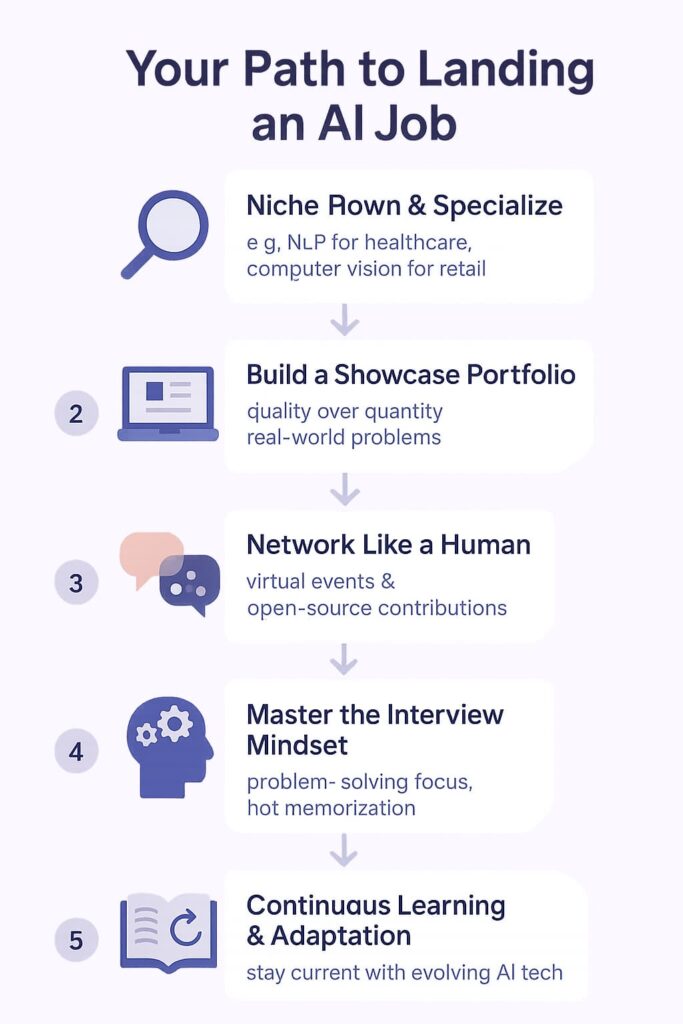
Wish to navigate your way into the buzzing world of AI? Here’s a streamlined, actionable five-step strategy to direct your efforts and ambition toward landing that coveted AI role.
Firstly, choosing specialization over generalization is key. There’s no room for the ‘all-rounder AI aficionado’. Pick up unique expertise, say, NLP in healthcare or computer vision in retail, and focus on it.
Secondly, craft an impressive portfolio. Don’t clutter it with miscellaneous work; remember, it’s quality that beats quantity. Convey your knack for resolving real-world, tangible problems through your projects, even if they are based on simulations.
Thirdly, shift to ‘Human Networking Mode’ instead of resorting to robotic LinkedIn outreach. Explore virtual meetups, open-source contributions, meaningful connections that can lead to unexpected opportunities.
The fourth step requires mastering the interview ‘mindset’. Don’t prioritize rote-learning algorithms; instead, emphasize your problem-solving abilities during technical interviews.
Lastly, never underestimate the power of continuous learning and adaptation. As the landscape of AI evolves at breakneck speed, staying updated isn’t just a choice—it’s a career imperative.
Go ahead, deploy this five-phase strategy. Steer your career to the fast-paced, exhilarating AI lane where learning, innovation, and opportunities abound.
Navigating through Mistakes: How ‘Weaknesses’ Can Trip Up AI Hopefuls
Let’s get one thing straight, everyone stumbles, and it’s no different when you’re taking your first strides towards an AI career. And yes, those same stumbles, or employee weaknesses, could potentially bar your success. Yet, on the flip side, recognizing and working on them may well become your stepping stones to growth.
Beware of the trap of generalization and muster the courage to dive deep into a specific domain. Employers are generally on the lookout for experts, not generalists.
Are you able to explain the impact of your past projects consistently? If you find yourself grappling with it, that may be a hurdle towards securing an AI job.
Clear and concise communication is another common stumbling block for many candidates. Remember, in the professional world, a solution that can’t be effectively communicated is nearly as good as no solution at all.
Then, there’s MLOps basics. Have you taken the time to get comfortable with them? If not, this is another red flag.
Lastly, did your ‘resume’ become a exhibition gallery of tutorials? Original projects, even if fewer, speak volumes about your problem-solving ability and are much more valuable.
Yes, there’s some homework to do. Yet, in acknowledging these common weaknesses, you’re inching closer towards turning them into the platform on which you’ll stand out as a strong AI candidate.
AI Job Hunt: Decoding the Intersection of Efficiency and Ethics
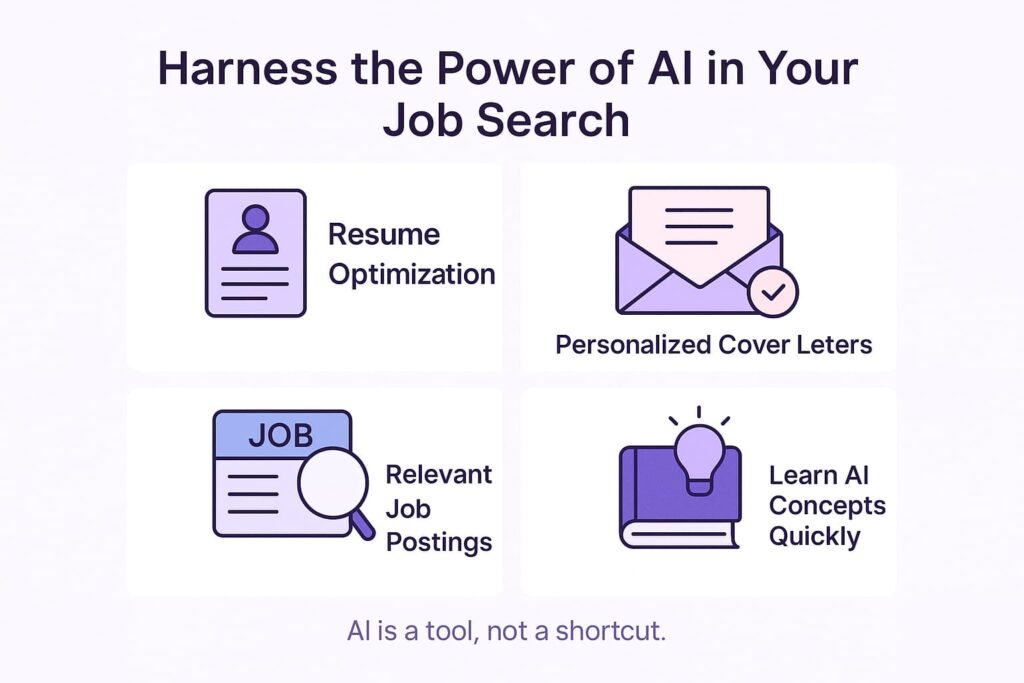
Ponder this for a moment. Could AI, the field you’re striving to break into, turn into your job-hunt ally? Well, not in some sci-fi, automated-future way but in an efficient, insight-driven manner. Using AI-driven tools to refine your job search strategy is akin to deploying your knowledge even before setting foot into the industry.
For starters, these tools offer assistance in tailoring your resume – bringing clarity to your experiences and achievements for a stronger impression. Then there’s the assistance with crafting personalized cover letters that resonate with potential employers. These tools also help you identify relevant postings, sparing you the frustration of sifting through a sea of unrelated job listings. Yet, always remember, these tools provide guidance and not an escape from human review.
Consider AI tools, an AI tool geared towards breaking down intricate concepts into digestible portions. Often cited as the best AI for homework, this tool can be a boon when preparing for technical interviews. Understanding complex AI papers or tackling coding challenges seems less daunting. Not to mention that the dreaded employee weaknesses – gaps in understanding and applying AI concepts – receive a robust retort.
Alpha to Omega, it’s about efficiency and learning, not crossing ethical boundaries.
So, if done judiciously, marrying AI with your job hunt can lead you to your desired threshold, more informed and better prepared. Guess what? You just practised employing AI without compromising ethics. Now, isn’t that an empowering way to start your AI career journey?
Preparing for the AI Interview: An Essential Checklist
Delving into the AI sector calls for more than just impressive tech skills. It’s also about how effectively you convey your understanding of those skills. Now, let’s glance through some critical pointers for your AI interview preps:
- Know your projects: Let your projects be the stories you narrate with passion. Understand them, inside out.
- Demystify complexities: Train yourself to distil complex ideas into straightforward explanations.
- Tackle behavioral questions: Come equipped to answer behavior-focused queries, especially those probing your problem-solving abilities.
- Be company-centered: Pinpoint the company’s products and trace how AI fits into the picture.
- Ask with insight: Conclude the session on a high note. Ask questions that reflect your understanding and genuine curiosity.
With these tips in your pocket, you’re well-placed to put your best foot forward in any AI interview. Remember, it’s not just about showcasing your skills, but also how you communicate them.
Your AI Career Awaits: Transform Plans into Action
Head into the AI field poised and armed with practical perspectives. Bridging the AI skills gap is achievable through strategic specialization, continuous learning, and robust networking skills. Creations that reflect your prowess belong in your portfolio – the proof of your abilities.
The path to fulfilling AI and data science roles exists, and it’s inching closer every day. You’re only a few steps away from landing your first AI job. Seize the day! Culminate your journey from being a tech enthusiast to becoming an accomplished AI professional. Start today.
Don the AI Career Cap: It’s Your Due Time
Landing your first AI job shouldn’t remain a vague ambition. This comprehensive guide has handed you the pathway with all the twists and turns outlined. Let’s remember, the pursuit of machine learning jobs or data science roles is not a sprint; it is a marathon. You will stumble and rise, but the destination is worth the journey.
We encourage you to share those bumps along the way right here in our comments section. Connect for a discussion, a problem encountered, or a story of triumph! And always bear in mind – stepping into the AI working world, you’re shaping the pulse of tomorrow.